%20--%3e%3csvg%20version='1.1'%20id='Layer_1'%20xmlns='http://www.w3.org/2000/svg'%20xmlns:xlink='http://www.w3.org/1999/xlink'%20x='0px'%20y='0px'%20viewBox='0%200%20100%20100'%20style='enable-background:new%200%200%20100%20100;'%20xml:space='preserve'%3e%3cstyle%20type='text/css'%3e%20.st0{fill:%23067EAA;}%20.st1{fill:%23FFFFFF;}%20%3c/style%3e%3cg%3e%3cpath%20class='st0'%20d='M85.8,33.4C86.6,51.7,57.7,97,55.1,97.1c-2.4,0.1-35.5-42.5-36.3-60.7c-0.8-18.3,13.5-33.8,32-34.6%20C69.3,0.9,85,15.1,85.8,33.4z'/%3e%3cpath%20class='st1'%20d='M70.9,31.5c0.4,9.9-7.6,18.3-17.9,18.7c-10.3,0.5-19.1-7.2-19.5-17c-0.4-9.9,7.6-18.3,17.9-18.7%20C61.7,14,70.5,21.6,70.9,31.5z'/%3e%3c/g%3e%3c/svg%3e)
Lost and Found Software for Festivals and Concerts
By Find-ItEvents
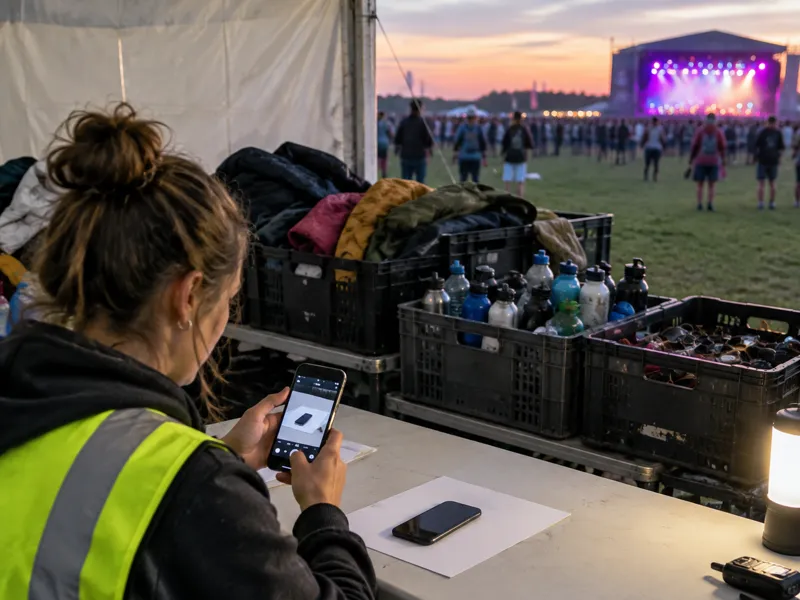
Festivals and concerts generate large numbers of lost items in a short period. Staff and attendees find items across stages, campsites, food areas, toilets and exits. A central lost and found point usually collects them, while many people report losses after they have already left the site. Paper logs and spreadsheets become hard to search and share once volume rises or multiple teams are involved. Dedicated lost and found software replaces those methods with one searchable system that works during the event and after it ends.
How does lost property work at a festival or concert?
Staff or attendees typically hand found items in at information points, security posts or a dedicated lost and found tent. Items are logged with a description, location and time, then stored securely. Valuables such as phones, wallets and keys are often kept separately. Attendees report losses on site or, more often, after they have left, by email, form or phone. Staff then search the records and verify ownership before releasing an item. Many events arrange collection during the event or shipping afterwards at the attendee’s expense.
Coachella provides an on-site Lost & Found near the main entrance and allows attendees to view items online or via the festival app during the event. Found items should be handed in at Info Kiosks or the Lost & Found, not to random staff. Glastonbury directs people to email lostproperty@glastonburyfestivals.co.uk after the festival with as much detail as possible, including photos where available, and notes that the team handles large numbers of enquiries.
Because sites are temporary and most attendees leave before items are fully processed, organisers need a clear process for matching claims, confirming ownership and arranging return or shipping after the event ends.
What this means for you: If your festival or concert still uses a shared notebook or spreadsheet that is hard to update across teams, a dedicated system can give every shift a single searchable record and reduce the time spent answering the same attendee questions by phone or email.
Why do festivals and concerts use dedicated lost and found software?
Festivals and concerts face practical pressures that paper or spreadsheet methods struggle with. Items arrive quickly from many areas of a temporary site, and staff on different shifts need access to the same records. Attendees often submit claims after they have left, sometimes from other cities or countries, so the system must support remote claim submission and clear matching. High volumes mean many enquiries arrive in a short window, and unclaimed items require documented disposal once the event ends. Multi-day or multi-stage events also need a consistent process while keeping records organised by day or area. These requirements make a dedicated system more practical than manual methods once volume or the number of teams grows.
What should festival and concert organisers look for in lost and found software?
Organisers typically need software that supports these practical requirements:
- Staff can log a found item on the spot from a phone, including a description, area or stage, and photo.
- Attendees can submit a claim online during or after the event through a link or form, so they do not have to call repeatedly.
- The system can match claims against found inventory and keep a clear status history from intake to return or disposal.
- Retention periods and disposal decisions can be tracked with a record of what happened to each item.
- Multiple stages, campsites or days can be managed under one account while keeping records organised.
- Role-based access with Admin and Staff roles, so frontline teams can log items with their own access level while managers retain oversight.
These capabilities help organisers reduce manual searching across a large site, improve the attendee experience for claims made after the event, and maintain clear records for high-volume operations.
What this means for you: Prioritise mobile logging by frontline staff, easy online claim submission that works after attendees have left, and clear tracking for shipping and disposal when evaluating options, because these features address the most common bottlenecks at festivals and concerts.
How does Find-It for Business support festival and concert operations?
Find-It for Business is a lost and found management platform for businesses. Staff can tag found items on the spot from their phone while still on site. Attendees can use a link or QR code on the organiser’s own branded lost and found page to submit claims during or after the event, and those claims are logged automatically. Claims, and public lost item listings posted on the Find-It consumer platform, are automatically matched with the event’s found inventory. The platform includes a documented digital claim process with ID and signature verification, plus status tracking that supports collection or shipping arrangements. Role-based access includes Admin and Staff roles so frontline teams can log items with their own access level.
The Free plan includes up to 5 items and 5 claims per month, 1 location and basic item management. Paid plans add a branded claim page with QR code, staff roles and permissions, more locations (so an organiser can manage several stages or sites under one account), and an embedded intake form on higher plans. See the pricing section for current details.
Frequently asked questions
How long do festivals and concerts usually keep unclaimed items?
Retention periods vary by event and local rules. Many hold items for a short period after the event ends before donating or disposing of them. Check the specific event’s policy.
Who usually logs found items at a festival or concert?
Frontline staff, security or information point volunteers typically find and log most items, while a central team handles attendee claims and returns.
Can attendees claim items after they have left the site?
Yes. Many events allow online claim submission or email enquiries so attendees can report a loss and check status remotely.
Where do items found at a festival usually end up?
Items are usually collected at information points or a central lost and found tent, then moved to secure storage. After the event they may be transferred to an office for further processing.
How can attendees describe where they lost an item?
Attendees should provide the stage or area, approximate time, date and any distinctive features of the item.